
Anti-Saccade (AS)
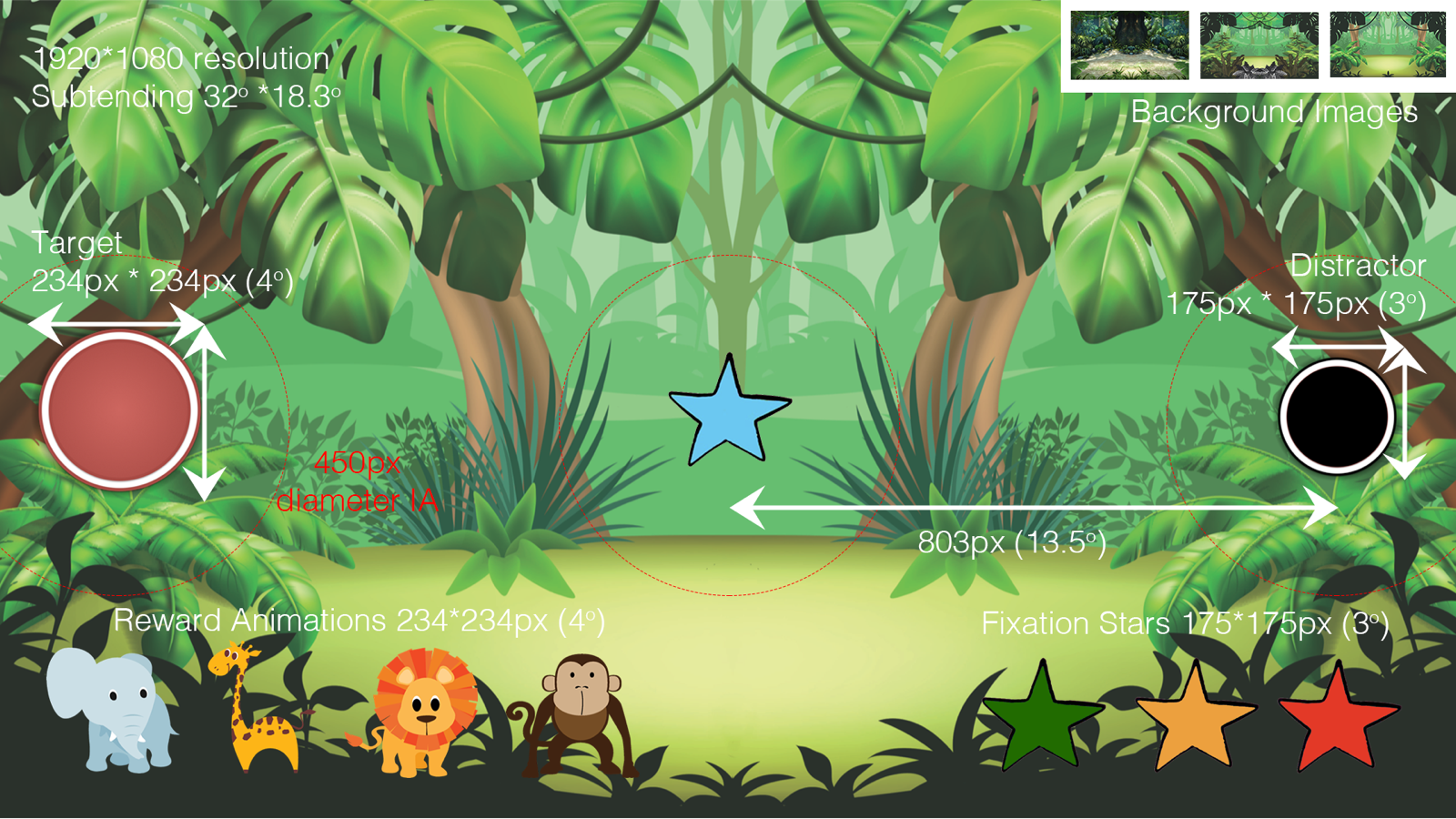
Fig. 1 Anti-Saccade and interest area placement and sizing.
Overview
The Anti-Saccade task has been widely used to examine saccadic movements and inhibitory
control and attention in clinical populations.Each trial begins with the presentation of one
of the four (randomly selected) fixation starts sized at 175*175px. Then, a black dot
(distractor) is presented after the participants have fixed their gaze on one of the randomly
selected central fixations. The distractor is 175*175px and is presented 803px to the
left or the right of screen center. After 1000ms, a red target is presented on the opposite side.
The target red dot is 234*234px, and after the participants have looked at it, is replaced
by a random selection from the four reward animations, which are also 234*234px. The goal
of the task is to look at the target as quickly as possible.
Conditions
- Pro-saccade
Participant’s gaze to distractor, then gaze to the target >100ms or more after its onset
- Corrective Saccade
Participant’s gaze to distractorm then gaze to the target before or within 100ms of its presentation.
- Anti-Saccade
No gaze to distractor, gaze to target before or within 100ms of its presentation.
Note
All conditions are defined by the participants own gaze beahviour and the critical period of behaviour is from the onset of the distractor until the onset of the targe image (except for the “Anti-saccade condition”)
Interest Areas
The fixation star, the distractor black dot and the target side (and red dot) each have
an elliptical 450px interest area (IA).
Gaze Triggers
The trials begin with an invisible boundary (IB) trigger around the fixation star animation,
which fires when gaze is held within the 450px diameter IA (500ms minimum duration).
This trigger onsets the distractor image (block dot), which is on screen for 200ms.
When the distractor image is shown, as well as when the following 1000ms period during
which only the background image is shown prior to the target image, there are IB triggers
around both the distractor dot and target location. There is 0ms minimum duration on
the distractor side IB (so that gaze to this side can be quickly identified without
interrupting potential corrective saccades). The target side saccades, which directly
trigger the reward animation have a minimum duration of 50ms (to ensure no misclassification
or saccades that are not held within the IA region). Finally, when the target red dot is shown,
there is a 0 IB trigger with a 0ms minimum duration that will fire immediately.
Classifiers
First, a Boolean (true/false) variable DISTRACTOR_SACCADE (DS) for whether gaze was
detected to the distractor IA during its presentation (200ms) or the following 100ms.
Second, if the first is true, a variable AS_DISTRACTOR_SAC_RT is updated with a reaction
time to the distractor from its onset to the first sample of the triggering gaze behavior.
Note that, if the first Boolean is false the second RT measure will be the default -1 value.
Third, a Boolean variable PREDICTIVE_SACCADE (PS) is updated to TRUE if gaze is detected
to the target side either before the onset of the target, or within 100ms of the target
onset. The fourth variable is AS_TARGET_SAC_RT is a reaction time measure formed of the
difference between the first sample to the target IA and the onset of the distractor dot,
this RT variable is also updated if the gaze triggers after the target onset (+100ms).
With this information some conditional triggers determine whether the trial is either an
anti-saccade, pro-saccade or corrective saccade. Below is a summary of trial labels:
Pro-saccade: Contains a true DS variable and a false PS variable.
Corrective saccade: Contains a true DS variable and a true PS variable.
Anti-saccade: Contains a false DS variable and a true PS variable.
Trials that do not meet these conditions, e.g. gaze only to the fixation star then the target after presentation, are deemed invalid.
Animations
- Fixation (start)
A fixation star throbs, changing in size between 50% and 100% at 1.5Hz.
- Reward Animation (start)
The reward animations shrink to 75% whilst rotating 45 clockwise for
500msthen return to 100% centered over500ms. They then shrink 75% and rotate anticlockwise for500msreturning to 100% and centered. The duration of the reward animation is2500ms.
Event Messaging
Because the task is designed to be run on both the Eyelink and EGI acquisition systems, Experiment Builder will send experiment messages to both systems. The messages sent to the Eyelink Host PC and to the EGI Netstation acquisition will differ slightly.
Eyelink
- Fixation Onset
The trial begins with the message
DISPLAY_FIXATION(onset of the star), followed by eitherGAZE_TO_FIXorTRIAL_TIMEOUT``(if not gaze within ``2500ms).- Distractor Onset (black dot)
When the distractor is shown (black dot),
ONSET_DISTRACTORis written. If the participant does not gaze to the target side after200msof the distractor onset, the distractor will disappear and the messageDISTRACTOR_OFFSET``is written. If the participant gazes directly to the distractor after its onset, or within ``200msof its offset,GAZE_TO_DISTRACTORis written.- Target Onset (red dot)
If the participant gazes directly to the target side before it onsets, or within
100msof its onset, thenPREDICT_TARGET_GAZEis written. If the participant gazes to the target side after100msof the target onset, thenGAZE_TO_TARGETis written. If the participant does not gaze to the target side within1000ms``of the target onset, ``TARGET_ONSETis written when the target is displayed. If no gaze is detected to the target side,TRIAL_TIMEOUTis written.- Reward Animation (star)
When the reward animation is shown, the message
"REWARD_ONSET"is written followed byTRIAL_END.- Trial Classification
The final message of the trial writes the result of the classifier (e.g,
"PRO_SACCADE","CORRECTIVE_SACCADE","ANTI_SACCADE"etc.).
EGI acquisition
EGI Netstation does not support the same event messaging as the Eyelink Host PC, as event codes are generally restricted to 4 characters. The table below shows the corresponding event codes for the EGI Netstation acquisition, and the DIN event triggered by the photo-diode on the screen for each event.
Eyelink Event |
EGI Event |
DIN EGI |
DIN EYELNK |
|
|---|---|---|---|---|
Condition |
Left |
Right |
||
|
dfxl |
dfxr |
DIN3 |
4 |
|
gfxl |
gfxr |
|
|
|
ddtl |
ddtr |
DIN2 |
2 |
|
gddl |
gddr |
|
|
|
gdtl |
gdtr |
|
|
|
dbgl |
dbgr |
|
|
|
dtgl |
dtgr |
DIN2 |
2 |
|
gttl |
gttr |
|
|
|
drwl |
drwl |
DIN3 |
4 |
|
N.A. |
N.A. |
N.A. |
|
|
N.A. |
N.A. |
N.A. |
|
Note
In addition to the event codes above, the following codes are also sent to the EGI
Netstation acquisition system, but they don’t contain a corresponding Eyelink event:
If the distractor offsets, and the participant gaze is on the distractor side gbdl
or gbdr are written, corresponding to whether the distractor was on the left
or right side of the screen. Alternatively if the participant looked to the target
side after the distractor disappears, then gbtl or gbtr are written, again
corresponding to the side of the screen that the target is on.